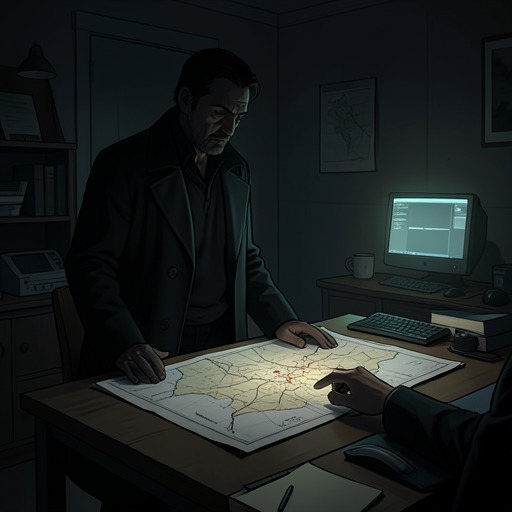
Aelita Banquet Non-Record Agreement
The PeripheralAelita’s gathering was held under a temporary, quasi-diplomatic agreement that prohibited recording by the host’s systems, the venue, or Flynne’s drone, while excluding news agencies and freelance reporters. The arrangement gave the event privacy but also left a consequential gap in the record: when Aelita West later disappeared, investigators could not simply turn to an ordinary archive of the gathering. The protocol therefore connects Flynne’s paid security work to the investigation, and makes the management of visibility central to the mystery.
Terms and Purpose
Ainsley Lowbeer described the gathering as operating under an agreement that nothing would be recorded. The restriction applied not only to Aelita West’s own systems, but also to Edenmere Mansions’ systems and to the drone Flynne was operating. News agencies and freelancers were kept away as well. The protocol thus combined limits on electronic capture with control over who could attend as an outside observer.
Lowbeer characterized the arrangement as temporary and quasi-diplomatic. It was not presented as a general rule for ordinary social occasions, but as a negotiated condition specific to Aelita’s soirée. The distinction matters: privacy here was not simply an absence of surveillance. It was organized through an agreement among the gathering’s participants and the institutions capable of recording or reporting what happened.
Flynne’s Assignment and the Gathering
The restriction defined the nature of Flynne’s job. She was responsible for security with her drone, yet the agreement barred that device from recording the event. Her role therefore placed her within the gathering’s security arrangements while limiting what her equipment could preserve. The protocol did not remove surveillance from the scene so much as draw a boundary around its permitted forms.
The novel also shows Flynne working amid observation outside that boundary. During another security shift, she sees fast-moving devices resembling double-decker dragonflies darting and hovering toward a building, apparently focused on its fifty-sixth floor. She calls them paparazzi and watches them retreat when she edges toward them. That episode does not establish that those devices were present at Aelita’s soirée; it instead sharpens the contrast between uncontrolled attention and the gathering’s explicit effort to keep news agencies, freelancers, and recording systems out.
Investigation and the Evidentiary Gap
After Aelita’s disappearance, Lowbeer tells Lev Zubov and the others that she is investigating the missing United States citizen who had been resident in London. She asks each person to explain their relationship to Aelita and to one another, making the conversation a matter of record. Lev points out the apparent contradiction: there are to be no recording devices. Lowbeer answers that she possesses court-certified recall, admissible as evidence. The exchange distinguishes the ban on recording devices from the later creation of an evidentiary account through Lowbeer’s own capacity.
The agreement also bears directly on Flynne’s possible access to the people who might know what happened. Lowbeer explains that Aelita’s soirée had used a similar no-recording protocol and that, if Flynne could not attend another party, they would not know whether a particular person was there. Privacy therefore restricts not just retrospective evidence but also the investigators’ ability to establish who was present in the first place.
Privacy, Surveillance, and Power
The protocol’s force lies in the asymmetry it creates. Aelita’s gathering is protected from routine recording by the host, the venue, and Flynne’s drone, and from the presence of outside reporters; later, however, Lowbeer can produce a court-admissible account from memory. The scene does not make information disappear. It raises the question of who is permitted to preserve it, by what means, and under whose authority.
That question is set against Lowbeer’s acknowledgment that she does not know everything. She describes an ocean of information and the limits of treating algorithmic decision points as a substitute for certainty. In this context, the no-recording agreement is more than a detail of elite etiquette: it helps explain why gaps persist even in a society rich in surveillance and data, and why investigation depends on access, testimony, and the unequal capacities of particular observers.